Friday, June 12, 2009

Biology and the Metzger Garden

This year with Science we did biology, and one just can't skip the family garden in biology!

Our books:
7th grade: Kingfisher Science Encyclopedia
4th grade: The Natural World by Lisa Watts

Reference: Square Foot Gardening
Lasagna Gardening

Our procedure:

4th grade:
Read, Narrate, Sketch, Experiment

7th grade:
Read, Outline, Sketch, Experiment

Our garden was just one 'experiments' of many, but it was the ongoing one, still in progress. Here is a slide show of some of our lettuce, our first harvest of the season :).


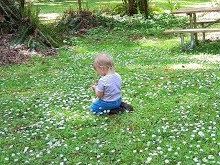
The younger girls just hung out and observed nature in an unschooling fashion. Just letting their natural energy flow. Freydis and I did a Charming of the Plough Blot for the gardens before they were planted. We galdored Fehu, and I believe that the energy raised has made our garden quite successful.

The boys have been tending the garden the most with watering, weeding, catching snakes :)


Ahhh....the natural world...

Just a little peak at our work:

Photobucket

Flower Anatomy - Gunnar

Seed Growing Process- Gunnar

Hail our Holy Mother Jorth!
FFF
Hyndla

Saturday, May 30, 2009

Foreign Language Suggestions

So for a possible upcoming trip to a certain South American location, our family is learning Spanish...yep I said it.....Never thought in a million years I would say it, but yes...Spanish. Asrekyr already knows tons of Spanish because he grew up in Rowland Heights...a non suburb, suburb...ahem....where as I was from total suburbia So Cal....LOL...OC! So I don't know a lick of it.

Astrid has already had 4 years of Latin and 2 years of Spanish, so she is a great resource, but we need instruction, so I got this cute series for the girls (really all of us) which is called Kids love Spanish.

It is by two sisters that are from So Cal who grew up learning Spanish.

Our girls love it. The ladies look like Folk, they can relate with the kids and it is colorful, clear and fun. I recommend it to anyone having 2-5 yos wanting to learn Spanish.

Our next favorite is....of course...MUZZY! We have been using the German one for years (now because where we are visiting that is a common spoken language ) We have the French and the Spanish one (which is having trouble working). We have so much fun with it, I suggest it for everyone. I have a blast with it.

Finally, Lyric Language Spanish, it is awesome. It is all songs, but very catchy and it teaches all the proper grammar and usage. We had the cd many moons ago for Astrid when she was little and she still remembers the songs. We now have the DVD AND CD and the DVD ROCKS. It is a sing-a-long with both english and spanish words. I REALLY like it and it is right up there with Kids love Spanish, but for older kids. AND the main family is Folk, which is easy for the kids to relate to and non distracting.

Next is Rosetta Stone. It is ok. I don't like the overtly multicultural brainwashing. Also, all the "Western" languages are multicultural, but the "Eastern" strictly Asiatic representations.....hmmm..... Think China had a hand in that? The teaching in it is good so far, but when a learning program has political subliminal messaging that is contrary to your beliefs, it is down right distracting and makes it MORE difficult to use.

Another don't...well don't if you are a visual learner. It is a cd set called Spanish Complete by VocabuLearn: Language Power. The whole thing is English word and spanish word. No rhyme or reason. I don't really get it...lol....I guess I am used to organized teaching first you learn the ABCs, family words, etc...Not this one. Only thing that is good is the pronunciation, so repeating them constantly is helpful there. If you are auditory...like Asrekyr...it will be more for you. :)

There are two websites that excellent foreign language resources: edhelper.com and enchantedlearning.com . For kids that is. We have printed off worksheets and laminated all their flash cards. These are membership sites, but only $20 a year each...very cheap as far as curriculum goes.

Ok enough blathering...stay tuned...I will be posting more info on curriculum and what works and what doesn't.

BTW...Thank you Frithwulf (an Odinic Sister in Cordoba, Argentina), you have been a huge help...she has answered all my naggy stupid questions about her country :D!

FFF
Hyndla

Tuesday, March 3, 2009

Happy Square Root Day!!

http://news.yahoo.com/s/ap/20090303/ap_on_fe_st/odd_square_root_day

Today is a special day that only happens 9 times in a century.

For Odinist's this is extra special since it is the square root of our most sacred number---9.

Hail the Nine Worlds!
Hail the Nine Waves that beget Heimdall!
Hail the Valknot!
Hail the Triskle!
Hail Odin, Vili, Ve!
Hail the Norns!

And last but not least,
Hail Faith, Folk and Family!
Hyndla OR

Sunday, February 22, 2009

Global Warming Presentation

Erika and I were lucky to catch a free presentation on Global Warming put on by our local library. It was quite a fiesty match of wits between those that believe in Global Warming, and those that believe it is a hoax. We are part of the latter.

Erika attends an alternative school here in Vancouver. She is taking Science and Algebra. In her Science class the teach played "An Inconvenient Truth" to purport that Global Warming is a reality. This movie by Al Gore is a travesty of lies and half truths as well as not having barely any scientific merit. I was appauled that the *Science Teacher* was teaching Al Gores theory as truth and science. So we decided that we would put together a written piece that relied on real science. It also, dispelled the myths that Al Gore was peddling as truth.

Part of her paper was this presentation. Erika sat in the front row and was able to hear and see all the evidence presented by both sides of the issue. Afterwards she commented on holes in the Global Warming theory. She also questioned some of the logic behind the arguments and the premises on which the theory relied. For instance, the climate record on which the global warming alarmists rely is only from 1975, although there is a 100 year record. Also, that the representative from Washington state kept connecting Global Warming to the ability to collect revenue from the residents of Washington State. We also were able to talk to a gentleman from the Cascade Policy Institute (http://www.cascadepolicy.org/), and he directed us to some free information. He also gave us kudos for our research into a hotly contested subject.

In the end, Erika was thrilled to go and see the debate first hand. Although we have "made up our minds", it is still important to hear the other side of the debate.

She turned in her controversial report and got an "A". Her teacher told her that it was well written and she was very strong in her opinion. :) Hopefully we educated her teacher a bit on the opposing view.

FFF
Hyndla OR

Tuesday, November 18, 2008

Classical Method-The closing

Personal Note

Our Family uses the Classical method via The Well Trained Mind by Jesse Wise and Susan Wise-Bauer. This Mother and Daughter teamed up to produce an excellent book that gives a combination of inspiration and step-by-step guide to Classical education. The above (very brief) overview of Classical education is result of our practical use of this method and understanding of those parts that are not yet used. We have found many positive results. For instance, the children are quickly grasping complex ideas and communicating them in their simple, yet rich, terms. It is fascinating to see that kind of understanding in an 8-year-old; or to simply be questioned (sometimes endlessly) about everything. Although we did have this to an extent, but there has been a marked improvement. One thing that we have experienced is the difficulty in finding material that was not heavily Christianized. This is wonderful for those of us that are Christians, but for those of us that are not, it is rather frustrating. My hope is that the more Odinist's and non Christians that use this method will build a body of work that future home educators will be able to utilize. Acorn Hollow is diligently working on just that idea!


“Education is not the filling of a vassel, but the igniting of a flame!” ~ Socrates

Hyndla OR

Works Cited/ Reference:

Wise-Bauer, Susan and Wise, Jessie; 1999. The Well Trained Mind .W. W. Norton & Company; New York. ISBN: 0-393-04752-0

www.welltrainedmind.com

Classical Method Part 2

Logic

The Logic Stage is exactly as it sounds, about logic! This stage begins with Fifth and finishes with Eighth Grade. During this stage of development, the young mind can now take the facts that they have learned and start using the rules of logic to make deductions, answer questions, and dissect facts. The logical child now starts to question the facts that he or she has learned. For instance, why did the Egyptian Empire fade away? Why did the Egyptians build pyramids? This is a vast change from the Grammar stage where the child was merely taught: Who were the Egyptians? This is also the stage where formal logic is taught. Logic is about analysis of structure and validity of information. The skills of logical analysis build upon the foundation of facts learned in the Grammar Stage. Although the child is still in the elementary stages of analysis, again, the beauty of Classical Education is the systematic and methodical building of a completed K-12 education, so the child is being taught to think logically a piece at a time to further prepare them for his or her next developmental progression into the ability to create arguments based on facts and logic: The Rhetoric Stage.

Rhetoric

It is absurd to hold that a man should be ashamed of the inability to defend himself with his limbs, but not ashamed of an inability to defend himself with speech and reason; for the use of rational speech is more distinctive of a human being than the use of his limbs.
~Aristotle, Rhetoric

The young adult has been taught the facts of life, the logical way to interpret them, and now will be taught how to use the gift of speech to present them. Typically this stage starts in Ninth Grade and ends with Twelfth Grade. This is when the young adult will start research, analysis, and presentation of information. All subjects will encompass this process. This stage of young adults life is marked by self-expression. As many know, the teenager is all a bustle about expressing his or herself in anyway possible. Aristotle goes on to say:

“…all men attempt to discuss statements and to maintain them, to defend themselves and to attack others. Ordinary people do this either at random, or through practice and from acquired habit.”

(Wise-Bauer, p. 452)

The Rhetoric Stage strives “to make success in speech a matter of skill and practice, not accident.” (Wise-Bauer, p. 452) The Rhetoric student will use all the skills gained up to this point to further master the ability to present ideas, facts, and studies of all subjects. This stage is about the finished product of a long study. Instead of simply learning about Da Vinci, or why he did what he did, the Rhetoric student will read, discuss, debate and present a complete study of this historical figure. The Rhetoric Stage not only completes the Trivium, but also prepares the child/young adult for partaking the Great Conversation.

The Great Conversation is the understanding, analyzing, and understanding of ideas of the past that have created the world we live in now. The goals of Odinist’s should include having our children a part of the Great Conversation. Do we not want our children to have a keen understanding of history, philosophy, and mathematics then to also be able to communicate these ideas appropriately through oral and written communication? Classical education provides the means to awaken the intelligence that resides within our children already. Furthermore, the Classical method considers the natural way children learn: systematically, slowly, and thoroughly.

Classical Method Part 1

For generations up to the Industrial Revolution, children were educated according to the Trivium of the Classical method. This method was credited for creating such leaders as George Washington and philosophers such as Aristotle. It is hoped that each Odinist family can use this method to enhance their own educational methods!

What is the Classical Method?

In a nutshell, the Classical Method is the way children learn through their various stages of development. Instead of forcing a child to look at History logically in second grade, the Trivium teaches that a child in the second grade is when you teach the “grammar” of history or to say it another way, the trivium during second grade is concerned with teaching facts. It is a very simple method that yields terrific results.

What is the Trivium?

The trivium consists of the Grammar, Logic, and Rhetoric stages of development. The Poll Parrot Stage has been included in recent years. People from birth to adulthood have a certain pattern of learning, which is reflected in this Trivium.

Poll-Parrot

Has one ever noticed that toddlers love to hear the same story (especially rhyming ones) repeatedly? This is in essence what the “Poll Parrot” stage of learning is about. Preschoolers love to imitate and learn well through imitation, repetition, and memorization. This stage a parent should encourage memorization through imitation and repetition. Consider, for instance, a four-year-old and Dr. Seuss. The child has the parent read the stories over and over again, he/she then imitate the parent reading while reciting the story from memory. Parents feel that this is tedious, but the preschooler absolutely loves it and is, in fact, learning! This is also where the timeless phrase: “Garbage in, Garbage out” comes into play. The beauty of Classical Education is that its method takes into consideration this unique learning phase and chooses to capitalize on it by filling the child’s mind with language, music, art, history, etc… The parent can give the child a valuable beginning in education. This understanding of the young mind help prepare the parroting preschooler for the “only the facts” primary schooler.

Grammar

Usually what comes to mind when a one thinks of Grammar is nouns, verbs, sentence structure, etc… Actually it is the Grammar of life and education that the child is learning. First through Fourth grade is considered the Grammar Stage. Think of this stage as the facts stage. The child is learning the foundational facts that support all subjects. It is vital in this stage that the child learns the fundamentals of life: Reading, Writing, and Arithmetic, or the three R’s. Although science, history, art, music, etc… are also a part of education, they are given the backseat to the foundations of learning. It may again be tedious education, but the Grammar stage student loves the facts and wants to learn the facts of life. Just as a journalist has to gather all the facts to give a fair and balanced report on a subject, so to does the student need the grammar of subjects to later understand them. Finally, the Grammar Stage mind can in Fourth Grade start the study of Latin. Up until about 50 years ago in public schools, Latin was a required subject in High School. For whatever reason, now Latin only resides in the curriculum of choice private schools. Latin makes the Logical mind think more efficiently. The child is not learning a new language, but a more systematic, logical way to analyze information. Fourth grade is the gateway into the Logic Stage where the foundation of facts and beginning of logic based thinking prepares for the next stage: Logic Stage.